
Denny Laughlin – Articles
Denny
by Joe Dundon
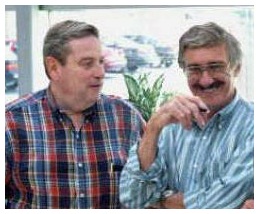
I believe he was Art Director from the beginning. He soon left for a few years to fulfill a military obligation, then returned to his previous position which he held until his retirement in May, 1999. He had great abilities in traditional art, portraits to landscapes. But he was also a master of design, print, photography, even carpentry. Denny could take a concept from discussion to the last nail or brush stroke.
And his Irish heritage, of which he was immensely proud, flowed out of him in charm, wit, laughter and loyal friendship.
Two stories: He and Bill Siminski, a director at WNDU-TV and former BOC advisor, were dangerous together. One lunch hour I remember, they kept staring out the WNDU front doors toward the massive 14-story Notre Dame Hesburgh Library.
Ad-libbing, they convinced our receptionist that the University was being forced to move the entire building 3 feet to the north because of FAA regulations of flight pattern disruption to planes landing at the South Bend Airport. On another occasion, I wandered into the studio during my first year there, and encountered Denny and Bill in a serious discussion. They were solving how to support the long ramp that needed to be built from the second-floor prop room, down above the stairs, smooth left turn through the large doors, and SWOOSH -- into the studio. This was, of course, for the new ski show we were doing. Artificial snow and all. I was 22. Green as a cucumber. I believed them.
Denny's commitment to BOC in 1972 was good timing for us. Prior to that, in addition to being the sales advisor, I spent our Saturday taping sessions teaching and supervising our student camera operators in the studio. A WNDU-TV director handled the sets, lighting, the direction and technical direction. That was to be our first year without a professional director, as BOC members became more involved in the total control of the production. So Denny taught and supervised the studio operations, which included set design and construction, lighting and camera work. Dave supervised audio, but mainly worked with the the directors and actors. Freed from the studio, I learned the nuts and bolts of the master control room switcher, and taught the technical directors. We all pitched in with projection room and videotape machine duties as needed.
When Dave Williams died in 1977, and the decision was made to continue the program on a year-to-year basis, "depending". It was Denny who provided the creative direction and became the lead advisor. With the critical help of Dan Lakin and Bob Medich, BOC grads, we got through that first year without Dave, and it was OK. But different.
In 1982, when WNDU opened its new building on campus, it was announced that there would be no more studio availability for BOC production. The station furnished some basic camera, lighting and recording equipment, and the show began taping 'on location', mainly at the Junior Achievement Center. I am less familiar with the program's production from this point on, since I had amicably parted after the '81 season and 13 years. Denny kept the project going, and BOC stayed relevant, funny and well-produced.
In 1986, however, Denny was told that the station would no longer sponsor a Junior Achievement company, since J.A. itself was re-organizing into a different educational entity. It was not spoken, but Denny and I believed that this was a financial decision by management, and had very little to do with Junior Achievement's changes. I think that BOC was looked upon more as a liability, an irritant, than an asset. If only they could have seen in 1986 the larger vista of what BOC was really producing year-in and year-out in men and women, in creative entertainment, and in present and future goodwill and national publicity for WNDU-TV and South Bend.
I know that many can see it now. Too late.
Thanks Denny. Thanks Dave. From all of us.
From the South Bend Tribune, Fall of 1965
Third 'Team' Gets into Game Action
By Laurance Morrison Tribune Staff Writer
Oh, to be sure, Notre Dame's and Pittsburgh's teams were there - any of the 59,051 persons in attendance will agree to that. So will the many television viewers.
That is where the third team comes in. While the collegians were exercising on the field, a contingent of men covertly took part in the game, and without ever setting foot in bounds.
The team, The TV Time-Out Guys. really run the show. The TV boys, like the Army football squads of `44 and `45, have a Mr. Inside" and a "Mr. Out- side." Inside WNDU's art director Dunny Laughlin.
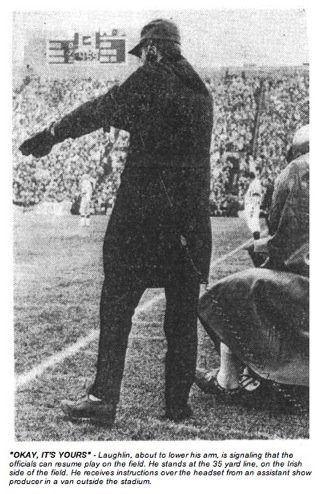
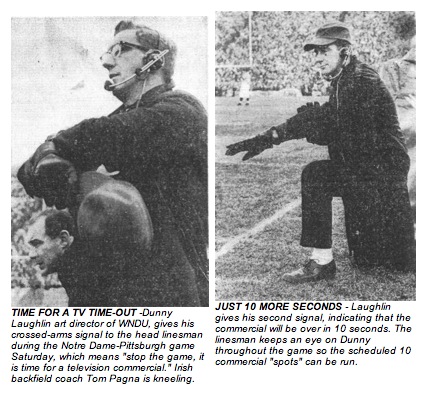
Dunny insconspicuously attired in flaming red peaked cap and telephone headset, was crouched on the ND. sidelines at the 35 yard line.
"What are you doing?" he was asked.
"Im the TV time-out guy." he replied proudly. "I signal the head linesman when it's time for a time-out so we can run a TV commercial."
"Why the red hat and the ear- phone get up?"
"That's so the linesman can see me. I wave my flaming red hat to get his attention. Then I stand with my arms folded to show that the commercial is running. Each one lasts one minute and 15 seconds. With 10 seconds remaining in the commercial, I drop my left arm, fingers together and pointing downward, and then game belongs to the officials again and play resumes."
"Oh, you don't mean you really control the game, do you?" What about the poor football teams? Didn't they practice all week for this game? After all, a team can work into a rhythm, develop a pace and keep the opponent reeling. That's the kind of teamwork and planning that produces touchdowns and victories. Yeah, what about the teams?"
"Well," Dunny said. "we do our best to keep out of the way. But we do have our basic minimum requirenients. We try like the devil to run two commercials in the first and third quarters and three of them in the second and fourth periods.
"Occasionally the teams get all worked up and it just wouldn't be very nice to interrupt things so we hold off-double up on commercials later on, you know, things like that, Laughlin said.
"But." he was asked, "did one of your commercials ever destroy a teams momentum?"
"Funny should mention that," he resounded "In the Army game this year. the officials got a little over-helpful and called a TV time-out for us." You might say Ara was some- what displeased since the Irish were starting to march."
"You never said what those earphones and mouthpieces are for," it was pointed out.
"Well, I'm the inside man. Outside the stadium, in our van. sits William Gardner, an assistant producer for the show, He and I talk over the phones and he consults with our man in the press box. When the moment seems pregnant, why we just call a time-out."
Laughlin, a 1955 graduate of Notre Dame who attended the old Central Catholic High School in South Bend, added that ABC national radio ordinarily follows his time-outs cues for their own commercials.
This is Laughlin's second season as time-out man. He mentioned that the principal occupational hazard is getting hit by cascades of players three or four times a game. He is tethered to a phone box by a four-foot coiled line, and when he sees trouble coming there's no place to go.
Being anchored is frustrating, he said. Sometimes, when there is little time remaining in a quarter and a commercial schedule is still unfilled, all he can do is jump up and down flapping his red hat trying to get the official's attention.
That very thing happened Saturday. Laughlin spent the closing minutes of the first period waving his flaming red hat, all to no avail. That lost commercial had to he made up later in the game.
Then too, with 13:15 remaining in the second quarter, the officials werent too obliging and called time-in, forcing the arupt ending of a commercial. The first commercial came just 59 seconds into the game. It's good to get one of them out the way," Laughlin commented.
And so the game, and the commercials, progressed. An Irish time-out at 8:58 of the third period was taken up by a snow-blower "spot." Then, with 2:55 to go in the tird quarter, after Tom Shoen scored on a long run, the ND. sudent body held its Go-o-o-o-o cheer and the band's drums rolled until the end of a commercial for a carpet store.
Following the Notre Dame, score making it 27-0, with 12:26 left of the fourth period, viewers were treated to a message from a meat packer.
At 9:37 to go in the game, a television manufacturer got an opportunity, thanks to Dunny, to demonstrate that Indians like TV inthe Arizona desert.
Lucky for Laughlin,the Notre Dames scored some more. Thus he was able to call another time-out and run a commercial normally set to appear after the game.
So, for genuine esoterica in football-watching, while looking for that guard to pull,or the defensive end to go wide, keep an eye out for Dunny Laughlin. It's what's on the sidelines that counts, you know.
From the South Bend Tribune
December 18, 2000
Longtime local TV creator dies Laughlin advised hundreds of teens in 'Beyond Our Control' By Andrew S. Hughes Tribune Staff Writer
SOUTH BEND -- Former WNDU-TV art director and "Beyond Our Control" adviser Dennis E. Laughlin died of cancer Saturday at Hospice House. He was 66.
Laughlin helped to invent local television during his 44-year career with the NBC affiliate.
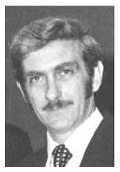
"He was pretty much the person we had gone to for decades to create or oversee how we would look, from television sets to logos, some of our photography, most kinds of promotional materials," Pierce said.
Laughlin's last major project for the station was overseeing the art direction for the station's May 1999 "Our House" project, a restoration of a house that was sold to a family as part of an effort to revitalize the Cushing Street neighborhood.
"He came up with a way to wrap the entire house in a big red ribbon," Pierce said. "He retired the day before our big party, and he showed up (at 5:30 a.m.) that day to make sure it looked good. He no longer worked for us; he just wanted to make sure it looked good."
Pierce said Laughlin brought "goodness" to local television.
"He wasn't doing TV just to do TV or because it was a job," he said. "He really loved it and thought it could do good for the community."
Laughlin's most significant contribution to local television was his role as an adviser on "Beyond Our Control," the Junior Achievement-sponsored sketch comedy program that ran on WNDU from 1968 to 1986, Pierce said.
Laughlin served as a consultant for the program's creator, Dave Williams, during the 1969 and 1970 seasons and became an assistant adviser in 1972. After Williams' death in 1977, he and WNDU sales executive Joe Dundon became the principal advisers for the program. Laughlin continued with "Beyond Our Control" until its cancellation in 1986, when Junior Achievement restructured its national program and withdrew support for projects such as "Beyond Our Control."
"I resisted it," Laughlin said of "Beyond Our Control" in an August interview with The Tribune for a story on the program's history and influence. "I saw these kids and thought it would drive me crazy. Once I started, I was sorry I hadn't been with it since '68. It just dominated my life, because I found these kids to be so bright and creative."
About 350 area high school students participated in the program during its 18-year run.
"I think he was a really good cheerleader for us, and Dave could be too, but he was in charge of keeping the show on track," Diane Werts said Sunday from her home in Princeton, N.J.
Werts, the television critic for Newsday, was a member of "Beyond Our Control" from 1971 to 1974.
"Denny was the one who could not worry so much about the nuts and bolts and just encourage creativity and spot unused talents in kids," she said.
Laughlin is survived by his three children, Erin Randolph of South Bend; Kelly Laughlin-Parker of Waukesha, Wis.; and Michael of Indianapolis. Visitation will be from 2 to 4 p.m. and 6 to 8 p.m. Tuesday at Welsheimer Funeral Home North, 17033 Cleveland Road. A funeral Mass will be conducted at 9:30 a.m. Wednesday at the Basilica of the Sacred Heart on the University of Notre Dame campus.
Staff writer Andrew S. Hughes: ahughes@sbtinfo.com (219) 235-6377
News coverage and editorial content from the South Bend Tribune unless otherwise specified.
From the South Bend Tribune
December 24, 2000
Laughlin went above and beyond for student tv show Television By Andrew S. Hughes Tribune Staff Writer
SOUTH BEND--Former "Beyond Our Control" members recalled Dennis Laughlin as the "heart" behind the show in the days following the retired WNDU-TV art director's death from cancer Dec. 16.
Laughlin worked at the local NBC affiliate from its inception in 1955 to May 1999, but he and others saw his involvement with the Junior Achievement-sponsored sketch comedy program as his legacy at the station.
Created by Dave Williams in 1967, "Beyond Our Control" ran on WNDU from January 1968 to April 1986. Laughlin worked with Williams during the 1968 and 1969 seasons and became a permanent adviser in 1973. After Williams' death in August 1977, Laughlin became the principal adviser until its cancellation.
In December 1999, Laughlin met with Diane Werts and Richard Xaver, both members of "Beyond Our Control" from 1971 to 1974, and Joe Dundon, a sales executive with WNDU and fellow adviser to the program from 1968 to 1981, to form an alumni association for the show. They've managed to locate a little more than half of the 350 area high school students who participated in "Beyond Our Control" during its 18-year run and plan a reunion the weekend of July 27-29, 2001, in South Bend.
Xaver oversees the "Beyond Our Control" Web site and has been making weekly trips from his home in Bloomington, Ind., to South Bend since Laughlin's cancer diagnosis this fall to visit and work together on the show's archives.
"His love for the show and for the people in it, and his joy for what it did for so many of us was so apparent," Xaver says. "Artists are always their own worst critics, and I think he felt that his contribution to the success of that program was no more and no less than anyone else's. I would disagree with that. I think that Denny's dedication and love for the program and his understanding of its effect on the people who worked on it was absolutely essential to keeping the show alive."
Dave Simkins, the executive producer of Fox's "Freaky Links," worked with Laughlin on "Beyond Our Control" from 1973 to 1977.
"I have this sense of Denny as a blur," Simkins said from his production office in California. "What I mean by that is running around the set, shifting ladders, making sure everything was ready. We would write these crazy sketches and wild stories, and it was up to us to build these props, but it was up to Denny to make sure it happened. Denny was always sort of in the background, but he was the one who made it happen."
Simkins and several other California-based "Beyond Our Control" alumni were together at a holiday party at the home of 1973-74 alumnus Steve Wyant when they learned of Laughlin's death the night of Dec. 16.
"We were all like 15 again," Simkins said. "I guess I always looked to Denny as sort of a gentle uncle. He was so nonjudgmental about what we were all trying to do and was just there to support us and make it easier for us to accomplish what we did. I think about how hard he worked on those Saturday mornings. This was a guy who had a family who was there on Saturday mornings helping a bunch of teen-agers. He didn't have to do that, but he did."
Werts echoed Simkins' thoughts and said Laughlin possessed an openness that made him "an artist in all aspects of his life" and that allowed him to work with people, especially teen-agers, without any preconceptions.
"He just accepted you as another human being, and that was just so important for somebody at that stage of life," the Newsday television critic said from her home in Princeton, N.J. "Not that he couldn't call you on the carpet, but it was never in the sense of an authority figure, but as a friend who had done more and seen more. He just wanted to help you grow into a nice, creative, fun person."
Andrea Rogers, a 1985 to 1986 "Beyond Our Control" alumna, said Laughlin was "extremely involved" in the show's production. She and her husband, 1986 company member Donnie Ehmen, own Grass Roots Media, a commercial and documentary video production company in South Bend.
"Because he was so involved in the program and had the utmost confidence in all these people, it kind of set the tone for the group," Rogers said. It was just nice to see an adult working with us in a different capacity than our other extracurricular teachers. He was more a part of what the group was doing than what I might have seen in some very dedicated adult advisers to student groups. He seemed to really enjoy it."
Wyant, an editor on the morning television show "Good Day L.A." on the Los Angeles-area Fox affiliate, returned to "Beyond Our Control" as a writing adviser from 1982 to 1984.
"Denny and I had a friendly relationship, sometimes at odds with each other," Wyant says of his second stint on the program. "Denny was the voice of reason. He had to have the final say on what we could get away with. My job was to push the limit. There was never an animosity between us, but there was always a give-and-take about what we could put on the air. ... I think we scared him once or twice, but whenever it was possible to get it on the air, he would do it."
Wyant says it's important to remember that Laughlin served as an adviser to "Beyond Our Control" longer than anyone else, and he "made the show work" for nine years after Williams' death.
"A lot of kids had a chance to be in this show because he picked up the reins, and they wouldn't have the jobs they have or be the people they are if he hadn't," he says.
Lee Lodyga followed his sister, Lynn Lodyga Disbrow, into the "Beyond Our Control" company for the 1981 to 1984 seasons. Disbrow had been with the company in 1977 and 1978, Williams' last year and the first year after his death.
"Going into the company, it was very important to me to live up to what I had grown up watching," Lodyga said from California, where he serves as the coordinator of product develop for EMI Music's catalog marketing group. "Denny always made you feel that you were as important and what we were doing was as important as anything that the company had done before. He made us feel that each year was special."
The students' humor could often provoke the ire of station management, but Lodyga said Laughlin hid that from the company members.
"You could tell when he had a bad meeting with WNDU, but it never came back to us," Lodyga said. "I remember stuff getting stopped, but if it wasn't stopped, it wasn't our fault. It was, but Denny always fought those battles. I don't think any of us knew how WNDU felt about us, except for the advisers. Denny took all that and really kept it separate, which was great because it didn't keep us from being creative. I think it was much more important to Denny that we grew and blossomed creatively. It was important to him that we never felt there were any barriers."
Bob Medich, a "Beyond Our Control" student from 1974 to 1978 and writing adviser from 1978 to 1979, said Laughlin's ability to produce a set, prop or logo under pressure "baffled" him at first.
"We would write something on Monday and he would have it by Saturday, and I was amazed by how he did that," Medich said from Chicago, where he works as the director of advertising and public relations at the Old Town School of Folk Music. "This was in the days before computers. Denny was a true artist. Everything was laid out or hand-drawn and made physically, whereas most graphics on television today are generated by computers."
He said the lessons he learned from the "Beyond Our Control" advisers continue to influence his and others' lives on professional and personal levels.
"Both Dave and Denny planted things in us that we still use today: the way you look at a problem creatively, the way you deal with people," Medich said. "This was a man who taught me so much about my creative self and gave me permission to do things, to take chances and find what's inside. I'll miss that. Whenever I talked to him, he was always enthusiastic about what you were doing. When I saw him in October, we didn't talk about his illness. We talked about what was , and we talked about what was next for me."
In a farewell letter to "Beyond Our Control" members, Laughlin wrote of his disappointment at not being able to attend the reunion, but recounted the joy planning it had given him and urged his former students to attend.
"In preparation for the reunion I have been watching old tapes, remembering casting, early crew, tedious production, but then the joy of standing around the monitor watching the results and gathering weekends to watch the show," Laughlin wrote. "Most of all I love watching the credits rolling to Nilsson's 'Remember ...', seeing all your names and being so proud that mine was there along with yours. I can't begin to tell you how much you mean to me and can never thank you enough for making my life so full and fun."
Staff writer Andrew S. Hughes: ahughes@sbtinfo.com (219) 235-6377
News coverage and editorial content from by
the South Bend Tribune unless otherwise specified.