
1986, Studio Y Magazine Article
by Denny Laughlin
Just east of the entrance to Holy Cross Junior College, construction crews were completing theirwork on the new WNDU-TV facilities. BOC advisors and company memberswere excited; the new studios would be spacious, and the station was investingheavily in new equipment. The show, it was felt, could only get better.
Meanwhile, the WNDU-TV News Department was about to convert entirely to electronic news gathering - 3/4" videotape cassettes would replace 16mm film, and the station's film processor was destined for salvage.This meant that BOC could no longer steal film from News for our trusty Bolex and piggy back the exposed film onto WNDU news film forprocessing. But BOC managed to con the news department out of an old field camera, a portable VTR and some batteries and so formed a summer company. Our Bolex - which had produced some of the most memorable productions in the show's history - was history itself, but the portable electronic equipment had given us another shot.
The show, it seemed, would go on.
Just east of the entrance to Holy Cross Junior College, construction crews were completing theirwork on the new WNDU-TV facilities. BOC advisors and company memberswere excited; the new studios would be spacious, and the station was investingheavily in new equipment. The show, it was felt, could only get better.
Meanwhile, the WNDU-TV News Department was about to convert entirely to electronic news gathering - 3/4" videotape cassettes would replace 16mm film, and the station's film processor was destined for salvage.This meant that BOC could no longer steal film from News for our trusty Bolex and piggy back the exposed film onto WNDU news film forprocessing. But BOC managed to con the news department out of an old field camera, a portable VTR and some batteries and so formed a summer company. Our Bolex - which had produced some of the most memorable productions in the show's history - was history itself, but the portable electronic equipment had given us another shot.
The show, it seemed, would go on.
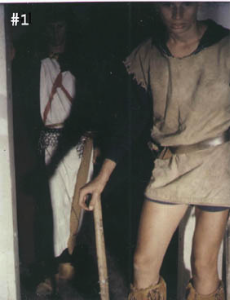
Steve Egyhazi as Robin Hood with Ken McCoy as the Sheriff of Nottingham. ('84)
It wouldn't be easy.
As the old facility in the shadow of the Notre Dame library was packing up and station personel anticipated the move to the brand-new studio complex across campus, department heads from the station met and decided that BOC would not be allowed to do any production in the new building. The station's investment in new equipment needed to be protected, it was argued. The transition to the new studios would be difficult enough, and BOC's possible disruptions to those operations was not worth the risk. The show itself was not cancelled; we just had no way to produce it anymore.
As the old facility in the shadow of the Notre Dame library was packing up and station personel anticipated the move to the brand-new studio complex across campus, department heads from the station met and decided that BOC would not be allowed to do any production in the new building. The station's investment in new equipment needed to be protected, it was argued. The transition to the new studios would be difficult enough, and BOC's possible disruptions to those operations was not worth the risk. The show itself was not cancelled; we just had no way to produce it anymore.
It was suggested we do something else with our airtime: "...like a sort of current events program; your single set of field equipment could still produce a "nice" show about what's going on in area schools." Sure.
From the ashes.
No Bolex - but we built a solution with a used field camera, recorder, and batteries. No studio - but could we build our own?
Equipment that was obsolete for WNDU came together to build something that just might work: a Control Room with switcher/keyer, an audio console, preview and air monitors, a VTR, a time base corrector and a b&w title camera. A studio with two video cameras, two tripods with dollies, 3 choker mics, 2 desk mics, a boom mic, floor monitor, a communication system, studio lights with stands and an assortmentof flats. For editing - two video tape machines, two monitors and a controller. For Location shooting - the original field camera, two portable VTRs, field monitor, battery packs and a battery charger.
On paper, it could work.
From the ashes.
No Bolex - but we built a solution with a used field camera, recorder, and batteries. No studio - but could we build our own?
Equipment that was obsolete for WNDU came together to build something that just might work: a Control Room with switcher/keyer, an audio console, preview and air monitors, a VTR, a time base corrector and a b&w title camera. A studio with two video cameras, two tripods with dollies, 3 choker mics, 2 desk mics, a boom mic, floor monitor, a communication system, studio lights with stands and an assortmentof flats. For editing - two video tape machines, two monitors and a controller. For Location shooting - the original field camera, two portable VTRs, field monitor, battery packs and a battery charger.
On paper, it could work.
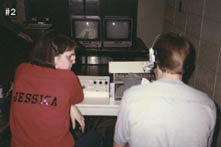
Andrea Rogers and Robby Brogle in the "Control Room." ('85)
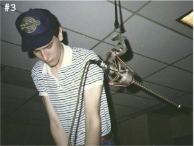
Bob Mowen hanging the boom mic. ('85)
In the midst of our summer projects, we took a handfull of veterans into the JA center on South Michigan and, with the help of an engineer from WNDU, put together a control room and studio. We performed and recorded a practice bit and it did work - so we recruited the '82-'83 company that September.
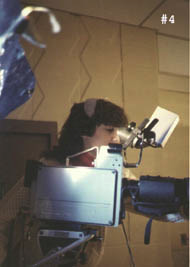
Erin Laughlin on camera. ('86)
Our first year was entirely produced in that horrible little building with glass walls, low ceilings and an ugly, shag carpeted floor that made trucking and dollying impossible. The only plus was a variety of rooms and offices that we used without benefit of permission. (This worked fine until someone discovered the JA director's liquor cabinet and I noticed that some props were looking too real.)
During our second season on our own, JA sold the Michigan Street building and moved to the second floor of the South Bend YMCA. This was great for us because the social hall made for a large studio with a good floor, high ceilings and far better acoustics. An adjacent storage room made an adequate control room, our weekly meeting room became a green room and prop storage center and we were given a small, private room that would be our editing room. We worked here for the remaining season and for the '85 and '86 seasons.
JA pulls the plug.
In 1986, Junior Achievement abandoned its high school, junior company program in favor of a middle school, in classroom approach to teaching busines and this was all WNDU management needed to bail out of its sponsorship of a TV company. And it was over.
As to field production versus film- well, we certainly missed the beauty of film but there are obvious benefits to video field recording. Being able to preview what you were shooting so that "what you see is what you get" was a big plus.
JA pulls the plug.
In 1986, Junior Achievement abandoned its high school, junior company program in favor of a middle school, in classroom approach to teaching busines and this was all WNDU management needed to bail out of its sponsorship of a TV company. And it was over.
As to field production versus film- well, we certainly missed the beauty of film but there are obvious benefits to video field recording. Being able to preview what you were shooting so that "what you see is what you get" was a big plus.
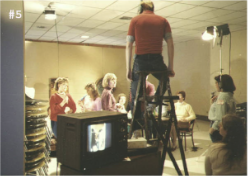
Rob Brogle directs from a lofty position. ('85)
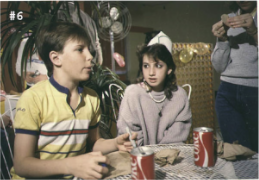
Chris Murphy and Stacy Spiegel rehearse a scene with Erin Laughlin directing. ('86)
Being able to practically record a scene in a variety of ways was another. There were no more sessions going down the tube because film was messed up in a vat of bad chemicals. And, of course, being able to record sound on location eliminated long and sometimes horrendous sound-tracking sessions.
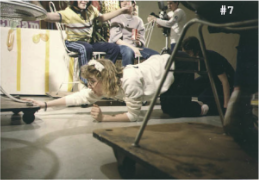
Lori Pfingst performs a BOC "special effect." ('86)
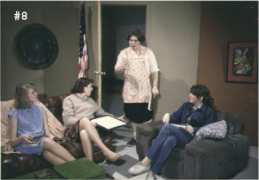
A scene from "Facts of Life" with Tasha Gutting, Andrea Rogers, Joe Haase as "Mrs. Garrity" and Erin Laughlin. ('85)
We did several large scale on location bits, Robin Hood being the most ambitious. Shot over six months in literally dozens of locations ranging from a complete village constructed on a huge Grape Road farm to a sword fight on the grand staircaseof the Morris Civic Auditorium, it was an elaborate, well costumed spectacular that could hold its own against Hercules and Tarzan. And it was a lot of fun.
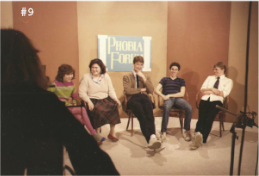
"Phobia Forum" with Maureen Kline, Lisa Costello, Bob Mowen and Robby Brogle. ('85)
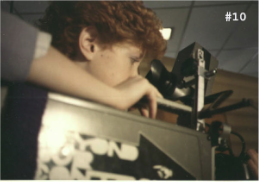
Samantha Luks on camera. ('86)